During CNC machining, abnormal noises between the machine tool, cutting tool, and workpiece often serve as direct indicators of mismatched machining parameters, tool wear, or unreasonable processes. Among these, the mismatch between spindle speed (S) and feed rate (F) is one of the most common causes of abnormal sounds.
This abnormal noise not only leads to excessive surface roughness and reduced dimensional accuracy of the workpiece but also accelerates tool wear, potentially causing severe malfunctions such as machine tool spindle vibration and tool edge fracture.
This article systematically dissects the types of abnormal noises caused by mismatched rotation and feed rates, sharing precise identification methods and efficient correction solutions to assist frontline technicians in quickly resolving issues.
Core Principle of CNC Speed and Feed Mismatch
The cutting process in CNC machining essentially involves the rotation of the tool's cutting edge at a specific speed while simultaneously advancing along a predefined path to achieve the removal of material from the workpiece.
The ideal speed and feed parameters must achieve a balance among the "three cutting elements" (cutting speed, feed rate, and depth of cut). The formula is: vc=1000π×D×n (vc= cutting speed, D= tool diameter, n= spindle speed)
When the spindle speed is too high and the feed rate is too low, the friction between the tool cutting edge and the workpiece intensifies, resulting in "scrape-type" cutting; when the spindle speed is too low and the feed rate is too high, the cutting force on the tool sharply increases, leading to "press-type" cutting.
Both of these imbalanced states can directly cause characteristic abnormal noises.
Identification and Cause Analysis of Different CNC Abnormal Noise Types
The abnormal noise caused by mismatched spindle speed and feed rate can be classified into three categories based on sound characteristics and machining phenomena, corresponding to different parameter mismatch issues.
1.sharp screech
Sound characteristics: a high-pitched, ear-piercing "screaming" sound accompanied by slight bed vibrations
Processing Phenomenon: Obvious tool marks appear on the workpiece surface, with rapid wear of the cutting edge and severe built-up edge
Core Cause: Excessive rotational speed and insufficient feed rate. The cutting speed far exceeds the material's suitable range, leading to friction between the tool and workpiece instead of cutting, which generates excessive cutting heat
2.Dull abnormal noise
Sound characteristics: low-frequency "thud" sounds, with noticeable vibrations when the tool contacts the workpiece
Processing Phenomenon: The workpiece surface is rough, with a high risk of tool edge chipping, and the spindle load value surges
Core Cause: Excessively low rotational speed and excessively high feed rate. The cutting force exceeds the tool's tolerance limit, preventing smooth material removal and resulting in squeezing and nibbling
3.Intermittent abnormal noise
Sound characteristics: Periodic "clunking" noise, with abnormal sound frequency synchronized to the spindle speed
Processing phenomenon: Periodic ripples appear on the workpiece surface, with significant fluctuations in dimensional accuracy
Core cause: The ratio of spindle speed to feed rate is unreasonable, resulting in uneven cutting intervals on the tool edge and periodic impacts between the tool and workpiece
4.Typical Scenario Examples
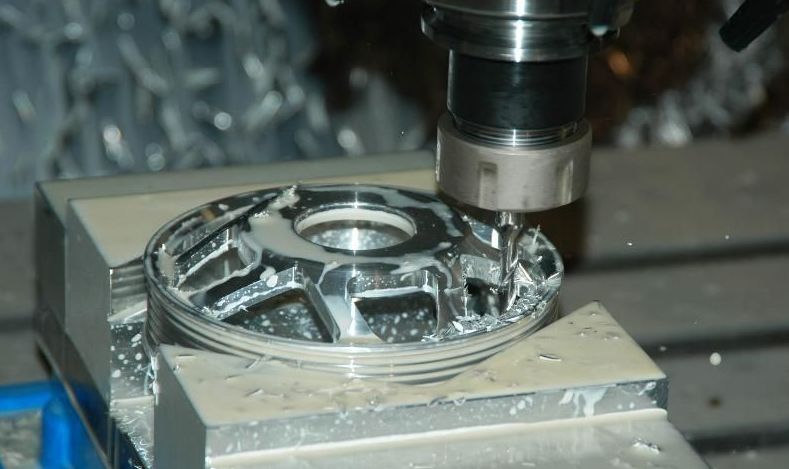
When machining 45# steel with a Φ10mm carbide end mill, setting the spindle speed to 5000r/min (far exceeding the recommended range of 1000~1800r/min) and the feed rate to 100mm/min immediately causes sharp啸叫, resulting in a blued tool edge and burrs on the workpiece surface.
When machining aluminum alloy with a Φ12mm drill bit, if the rotational speed is set to 500r/min (far below the recommended range of 2000~3500r/min) and the feed rate is set to 500mm/min, dull abnormal noises will occur, the drill bit is prone to deviation, and the hole wall will be rough.
Effective Correction Solutions for Speed & Feed Mismatch Noise
For different types of abnormal noises, it is necessary to follow the principle of "first determining the mismatch direction, and then adjusting the parameters step by step", and make precise corrections based on the tool material, workpiece material, and machining process (rough/fine machining).
1. Correction of sharp whistling (high speed, low feed)
Core idea: Reduce the speed, increase the feed rate appropriately, and restore the normal cutting state.
specific steps
Reduce speed: Reduce the current speed by 30%~50%, referring to the cutting speed range provided by the tool manufacturer (the cutting speed for hard alloy tools to process steel is usually 50~100mm/min).
Increase feed rate: According to the formula of single tooth feed rate fz=n × ZF (Z=number of tool teeth), adjust the single tooth feed rate to the appropriate range (the single tooth feed rate for end mill machining steel is 0.01~0.04mm/tooth).
Validation optimization: If the abnormal noise disappears after trial cutting and the surface of the workpiece is smooth, the speed and efficiency can be slightly increased; If there is still a slight abnormal noise, continue to reduce the speed.
2. Correction of dull abnormal noise (low speed, high feed)
Core idea: Increase the rotational speed, reduce the feed rate, and decrease the cutting load of the tool.
specific steps
Increase speed: Increase the current speed by 20% to 40% to ensure that the cutting speed meets the minimum requirements for material processing.
Reduce feed rate: Reduce the feed rate by 20% to 30% to avoid cutting forces exceeding the rigidity limit of the tool and machine tool.
Auxiliary measures: If processing processes with high loads such as deep holes and grooves, the cutting depth can be appropriately reduced, and multiple cutting can be carried out to further reduce tool pressure.
3. Correction of intermittent abnormal noise (unreasonable speed feed ratio)
Core idea: Adjust the ratio of speed to feed to make the cutting edge cutting interval uniform and eliminate periodic impact.
specific steps
Calculate the current ratio: Calculate the ratio of speed to feed rate n/F, and observe whether there is an integer multiple relationship with the number of tool teeth and workpiece structure.
Fine tuning parameters: Slightly adjust the speed or feed rate (± 10%) to break the frequency matching of periodic impacts; Prioritize adjusting the speed to avoid affecting the feed rate and surface quality.
Process optimization: If there is still abnormal noise after adjusting parameters, the tool path can be optimized to increase cutting smoothness.
Refer to the basic parameter table:
Before adjustment, the cutting parameters provided by the tool manufacturer should be used as a reference, and fine tuned according to the actual working conditions (machine rigidity, fixture stability) to avoid blind trial and error.
Distinguish between rough and fine machining:
rough machining can increase the feed rate and reduce the speed appropriately to prioritize machining efficiency; Precision Machining requires increasing the rotational speed, reducing the feed rate, and prioritizing surface quality.
Pay attention to auxiliary factors:
Abnormal noise is not only caused by parameter mismatch, but also by tool wear, fixture loosening, and insufficient cutting fluid. Before adjusting parameters, it is necessary to check the tool edge status, fixture clamping force, and cutting fluid injection position.
Priority for trial cutting verification:
After parameter adjustment, it is necessary to conduct a small margin trial cutting. By listening to sound, observing the surface of the workpiece, and checking the tool status, it is confirmed whether the abnormal noise has been completely eliminated.
FAQs About CNC Machining Noise and Parameter Matching
What is the main cause of CNC machining abnormal noise?
A1: The most common reason is speed and feed mismatch. Unmatched spindle speed and feed rate cause tool vibration, resonance and cutting resistance imbalance, resulting in abnormal noise.
Q2: How to eliminate CNC noise caused by parameter mismatch?
A2: Identify noise types first, adjust spindle speed and feed rate reasonably, follow scientific parameter matching principles, and avoid over-cutting and tool vibration.
Q3: Will speed feed mismatch affect CNC part quality?
A3: Yes. It will cause tool marks, poor surface finish, tool wear and even part deformation.
The abnormal noise in CNC machining is a "fault warning signal" issued by the machine tool. The mismatch between rotational speed and feed rate is one of the core causes of abnormal noise. By identifying the sound characteristics of abnormal noises, determining the direction of parameter mismatch, and then adjusting according to the principles of "reducing speed and increasing feed rate" or "increasing speed and decreasing feed rate", a stable cutting state can be quickly restored.
In actual production, the machine adjustment personnel need to combine the actual conditions of tools, workpieces, and machine tools, and accumulate experience in parameter adjustment, so as to achieve the goal of efficient processing of "listening to sound to identify faults, and accurately adjusting parameters".






 Phone
Phone
Comment
(0)