What Is Military CNC machining? Definition, Applications & Industry Overview?
Military CNC Machining refers to precision computer numerical control manufacturing services dedicated to national defense, military and aerospace defense sectors. Unlike standard commercial machining, military-grade production requires not only high dimensional accuracy, but also strict compliance with defense industry specifications, full material traceability, documented quality control processes and information confidentiality control.
Typical applications of military CNC parts include aerospace defense systems, ground combat equipment, naval vessel components, weapon systems, tactical communication devices, optoelectronic sighting equipment and missile guidance structures. Every part must meet strict performance, reliability and environmental adaptability requirements to ensure stable operation under extreme conditions such as high impact, wide temperature range, corrosion and vibration.
In essence, military CNC machining is a comprehensive manufacturing system integrating precision processing, quality verification, compliance management and supply chain security, rather than a simple cutting process.
Military vs. Commercial CNC Machining: Key Differences in Tolerances, Materials & Requirements
The core difference between military and commercial CNC machining lies not in equipment alone, but in the entire quality management system, compliance standards and traceability requirements. The table below systematically compares the main differences between the two:
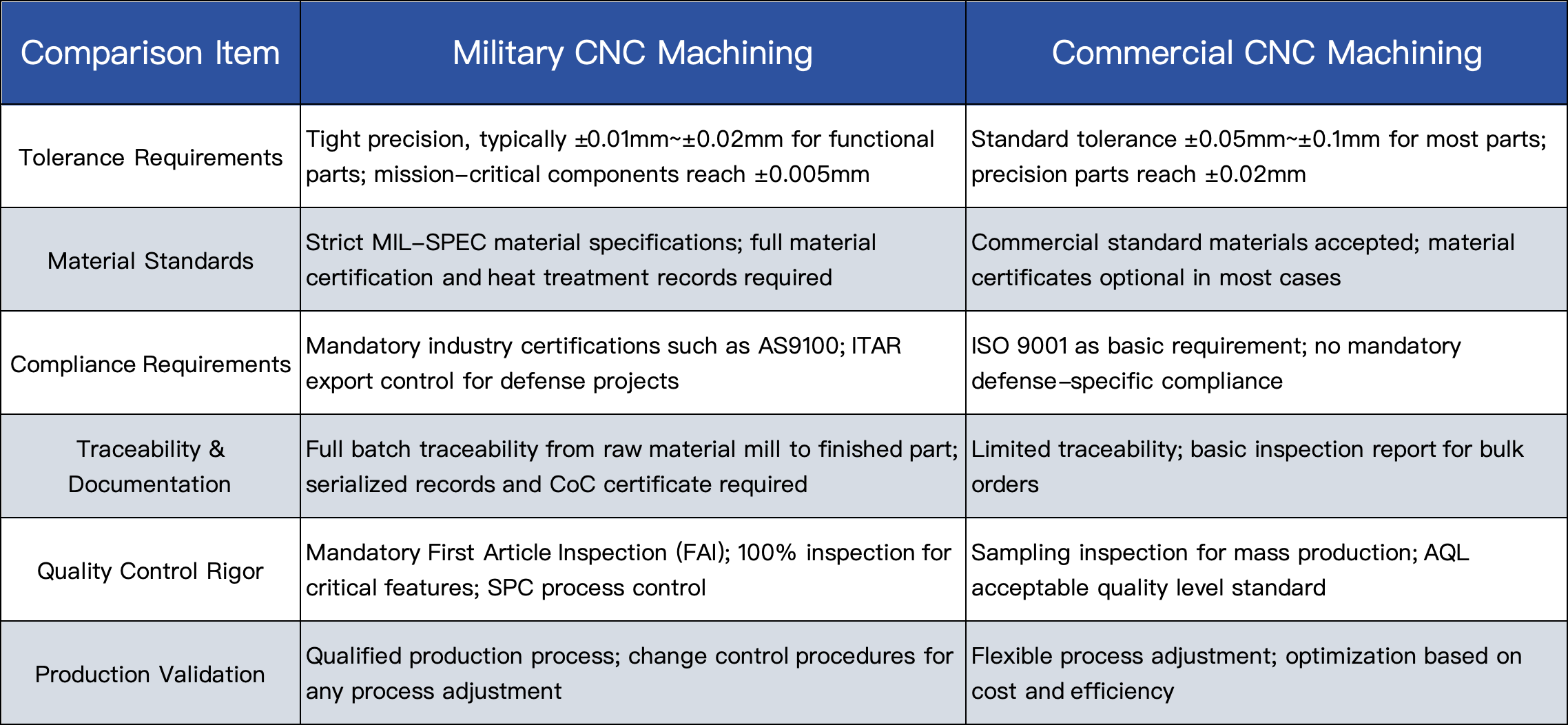
Beyond technical indicators, military machining places greater emphasis on process reproducibility, audit readiness and long-term supply chain stability, to ensure consistent part quality across different production batches and long product lifecycles.
Military-Grade CNC Materials & Machining Tolerances: Common Alloys and Specifications
Material selection is the foundation of military part performance. Military-grade materials must meet specific strength, toughness, corrosion resistance, high temperature resistance and fatigue life requirements, with strict matching machining tolerance standards. The following are the most commonly used alloys in military CNC machining:
Aluminum Alloys
Common Grades: 6061-T6, 7075-T6, 2024-T3
Key Properties: High strength-to-weight ratio, good machinability, excellent corrosion resistance
Standard Tolerance Range: ±0.01mm ~ ±0.03mm
Typical Applications: Aircraft structural parts, housing components, communication equipment chassis, lightweight weapon accessories
Titanium Alloys
Common Grades: Ti-6Al-4V (Grade 5), Ti-6Al-4V ELI
Key Properties: Ultra-high strength-to-weight ratio, excellent corrosion resistance, high temperature resistance, biocompatibility
Standard Tolerance Range: ±0.005mm ~ ±0.02mm
Typical Applications: Aerospace engine components, missile structures, medical implant devices for military use, naval corrosion-resistant parts
Stainless Steels
Common Grades: 304, 316L, 17-4PH, 15-5PH
Key Properties: Good corrosion resistance, high strength, excellent mechanical properties, hardenable
Standard Tolerance Range: ±0.01mm ~ ±0.02mm
Typical Applications: Weapon components, naval equipment, fluid control valves, precision instrument structures
High-Temperature Superalloys
Common Grades: Inconel 718, Hastelloy C-276, Monel 400
Key Properties: Extreme high temperature resistance, excellent corrosion and oxidation resistance, high creep strength
Standard Tolerance Range: ±0.02mm ~ ±0.05mm (rough machining); ±0.005mm ~ ±0.01mm (finish machining)
Typical Applications: Turbine engine components, rocket motor parts, exhaust system structures, extreme environment working parts
Tool Steels & Alloy Steels
Common Grades: 4140, 4340, A2 Tool Steel, H13
Key Properties: High hardness, good toughness, excellent wear resistance, heat treatable
Standard Tolerance Range: ±0.01mm ~ ±0.02mm
Typical Applications: Weapon barrel components, gear parts, tooling fixtures, armor structural components
General Tolerance Grading for Military Parts:
General structural parts: ±0.05mm ~ ±0.1mm
Precision functional components: ±0.01mm ~ ±0.02mm
Mission-critical ultra-precision parts: ≤ ±0.005mm
Military CNC Compliance Explained: AS9100, MIL-SPEC & ITAR Requirements
Compliance is the core threshold for entering the military and aerospace defense supply chain. Three major regulatory systems define the basic requirements for military CNC machining: quality management system standards, technical specification standards and export control regulations.
AS9100 / AS9100D Quality Management System
AS9100 is the international quality management system standard specifically for the aerospace, defense and space industries, developed on the basis of ISO 9001 with additional requirements for defense and aviation scenarios.
Core Requirements: Documented manufacturing processes, full product traceability, risk management, mandatory First Article Inspection (FAI), engineering change control, special process validation and personnel qualification management.
Industry Significance: It is the basic entry certification for the global aerospace and Defense Manufacturing supply chain. Without AS9100 certification, suppliers cannot formally enter the qualified vendor list of major military contractors.
MIL-SPEC (Military Specifications)
MIL-SPEC refers to a series of technical specifications and standards formulated by the U.S. Department of Defense for materials, processes, parts and products, used to ensure uniformity, reliability and interchangeability of military supplies.
Common Categories:
MIL-STD: General engineering and testing standards (such as MIL-STD-105 sampling inspection, MIL-STD-1913 dimensioning and tolerancing)
MIL-PRF: Performance specification standards for finished products
MIL-M: Material specification standards for raw materials and semi-finished products
MIL-STD-150: Technical drawing and dimensioning standards
Industry Significance: All raw materials, processing techniques, inspection methods and finished products must meet the requirements of corresponding MIL specifications, with complete supporting documentation as delivery accessories.
ITAR (International Traffic in Arms Regulations)
ITAR is the U.S. International Traffic in Arms Regulations, which controls the export, transfer and disclosure of defense-related articles, services and technical data.
Core Requirements for Machining Facilities: Controlled facility access, classified technical data protection, restricted foreign national access, export license management and complete access record keeping.
Industry Significance: Any CNC machining service involving U.S. defense technical data or defense articles must comply with ITAR regulations. Non-compliance will result in severe legal penalties and permanent disqualification from the defense supply chain.
In summary, AS9100 is the basic quality management foundation, MIL-SPEC defines technical execution standards, and ITAR sets the export control threshold. The three systems together form the complete compliance framework for military CNC machining.
Quality Control & Traceability in Military CNC Machining: How Parts Are Verified
Quality control for military CNC machining runs through the whole production process from incoming material inspection to finished product delivery, with complete traceability records for every key node.
First Article Inspection (FAI)
Before mass production, the first manufactured part must undergo full dimensional verification, material composition testing, performance testing and documentation review. A complete FAI report includes all dimensional data, material certificates, heat treatment records and surface treatment test reports, which is a prerequisite for formal batch production approval.
In-Process Quality Control
Each processing procedure is subject to staged inspection according to process documents. Key characteristics adopt 100% full inspection, and mass production features adopt Statistical Process Control (SPC) to monitor process stability. Tool wear, equipment status and environmental parameters are recorded synchronously to ensure process reproducibility.
Full Material Traceability
Every batch of parts retains complete traceability records from raw material to finished product, including raw material mill test report (MTR), heat number, batch number, processing route, operator information, inspection records and shipping information. Each part can be traced back to the original steel mill material information through the batch number.
Final Inspection & Certificate of Conformance (CoC)
Finished parts undergo full final inspection according to drawing requirements. Qualified products are issued with a Certificate of Conformance (CoC), which declares that all parts meet drawing specifications, material standards and relevant industry requirements, with supporting inspection reports and material certificates attached.
Non-Conformance Control
All non-conforming products are isolated, identified and reviewed according to standardized procedures. Root cause analysis and corrective & preventive actions are implemented, with complete records retained for audit. Any engineering change must go through formal change control procedures.
How to Qualify a Reliable Military CNC Machining Supplier: Audit & Verification Checklist
Selecting a military CNC machining supplier cannot be based solely on price. Compliance qualifications, quality system completeness and industry experience are the primary evaluation criteria. The following checklist covers core audit dimensions:
Certification & Compliance Verification
Valid AS9100 / AS9100D certification with scope covering your part type
ITAR registered facility (for US defense projects) or relevant export control compliance capability
Proven experience in manufacturing parts according to MIL-SPEC standards
Special process certifications (heat treatment, surface treatment, NDT testing)
Material Sourcing & Traceability Capability
Formal approved material sourcing channels with complete mill test report (MTR) support
Complete batch traceability system covering material, processing, inspection and delivery
Ability to provide full material certification and heat treatment documentation
Precision & Tolerance Capability
Modern high-precision CNC equipment with verified positioning accuracy
In-house calibrated inspection equipment (CMM, optical comparator, surface roughness tester, hardness tester)
Proven track record of tight tolerance machining for mission-critical parts
Quality Management System Maturity
Standardized First Article Inspection (FAI) process and formal report output capability
Documented work instructions for every processing procedure
Formal non-conformance management and corrective action system
Complete document control and record retention mechanism
Defense Industry Experience
Past project references in aerospace defense, military equipment or related sectors
Understanding of defense industry quality requirements and delivery procedures
Long-term cooperation experience with tier 1 or tier 2 defense contractors (preferred)
Security & Confidentiality Control
Facility access control system and visitor management procedures
Technical data security and confidential information protection measures
Employee confidentiality agreements and controlled data access permissions
In short, a qualified military CNC supplier should have complete compliance qualifications, mature quality systems, proven precision capabilities and reliable information security mechanisms, rather than just low price advantage.
What tolerances can military CNC machining achieve?
Standard military CNC machining achieves ±0.01mm ~ ±0.02mm tolerance for most functional parts. Mission-critical ultra-precision components can reach ±0.005mm or finer, depending on material characteristics and part structure. General structural parts follow ±0.05mm ~ ±0.1mm standard tolerance.
What is the most commonly used material for military CNC parts?
Aluminum alloys (especially 7075-T6 and 6061-T6) are the most widely used materials for military CNC parts due to their excellent strength-to-weight ratio and good machinability. Titanium alloys, stainless steels and high-temperature superalloys are selected for special working conditions such as high strength, corrosion resistance and high temperature scenarios.
What does ITAR compliant mean for a CNC machine shop?
For a CNC machine shop, ITAR compliant means the facility meets U.S. International Traffic in Arms Regulations requirements, including controlled facility access, protected defense technical data, restricted foreign national access, proper export licensing and complete record keeping. It is a mandatory requirement for processing U.S. defense-related parts and technical data.
Is AS9100 certification required for military CNC machining?
AS9100 is the standard baseline certification for the aerospace and defense manufacturing supply chain. Most prime defense contractors require their suppliers to hold valid AS9100 certification as a prerequisite for vendor qualification. It is widely recognized as the basic entry threshold for military and aerospace machining services.
What is the difference between MIL-SPEC parts and commercial parts?
MIL-SPEC parts are manufactured and tested according to U.S. military specification standards, with strict material requirements, full traceability, mandatory inspection and complete compliance documentation. Commercial parts follow general industry standards with more flexible requirements. MIL-SPEC parts offer higher reliability, interchangeability and long-term traceability for defense applications.
Get a Military-Grade CNC Machining Quote Today
Military-grade CNC machining demands more than precision — it requires verified compliance, complete traceability and uncompromising quality control. Whether you are developing defense components, aerospace subsystems or mission-critical hardware, working with a certified and experienced partner is essential to meet program deadlines and regulatory requirements.






 Phone
Phone
Comment
(0)