Mining equipment operates under extreme conditions: high abrasive wear, heavy impact loads, continuous dust and variable temperatures. Even minor dimensional deviations in machined parts can cause accelerated wear, sealing failure, improper gear meshing and unplanned downtime. For mining operations, downtime costs far exceed manufacturing costs — Precision Machining is not a premium expense, but a core means to extend component service life and reduce total operating costs.
Custom CNC machining ensures consistent fitting accuracy, optimized stress distribution and compatibility with wear-resistant materials, directly improving the reliability and maintenance cycle of crushers, conveyors, excavators and drilling equipment.
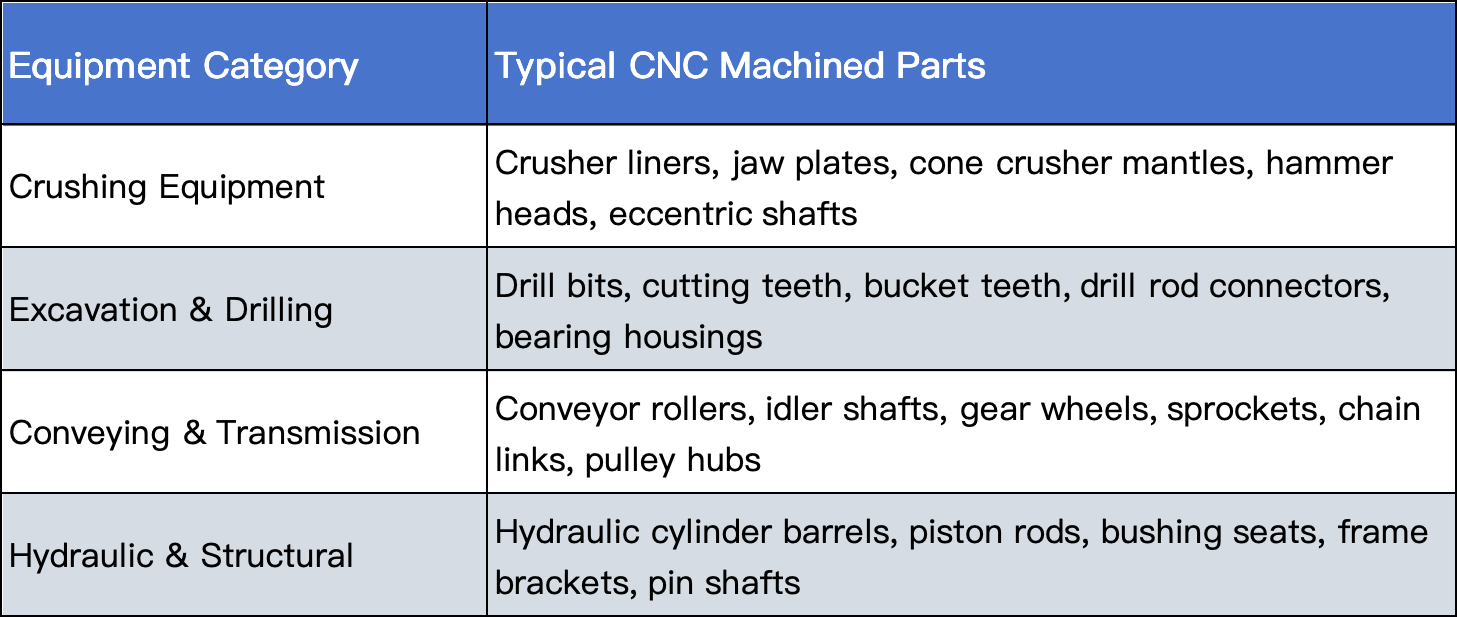
Mining equipment relies on a wide range of custom machined wear parts. The most commonly CNC-manufactured components fall into four categories:
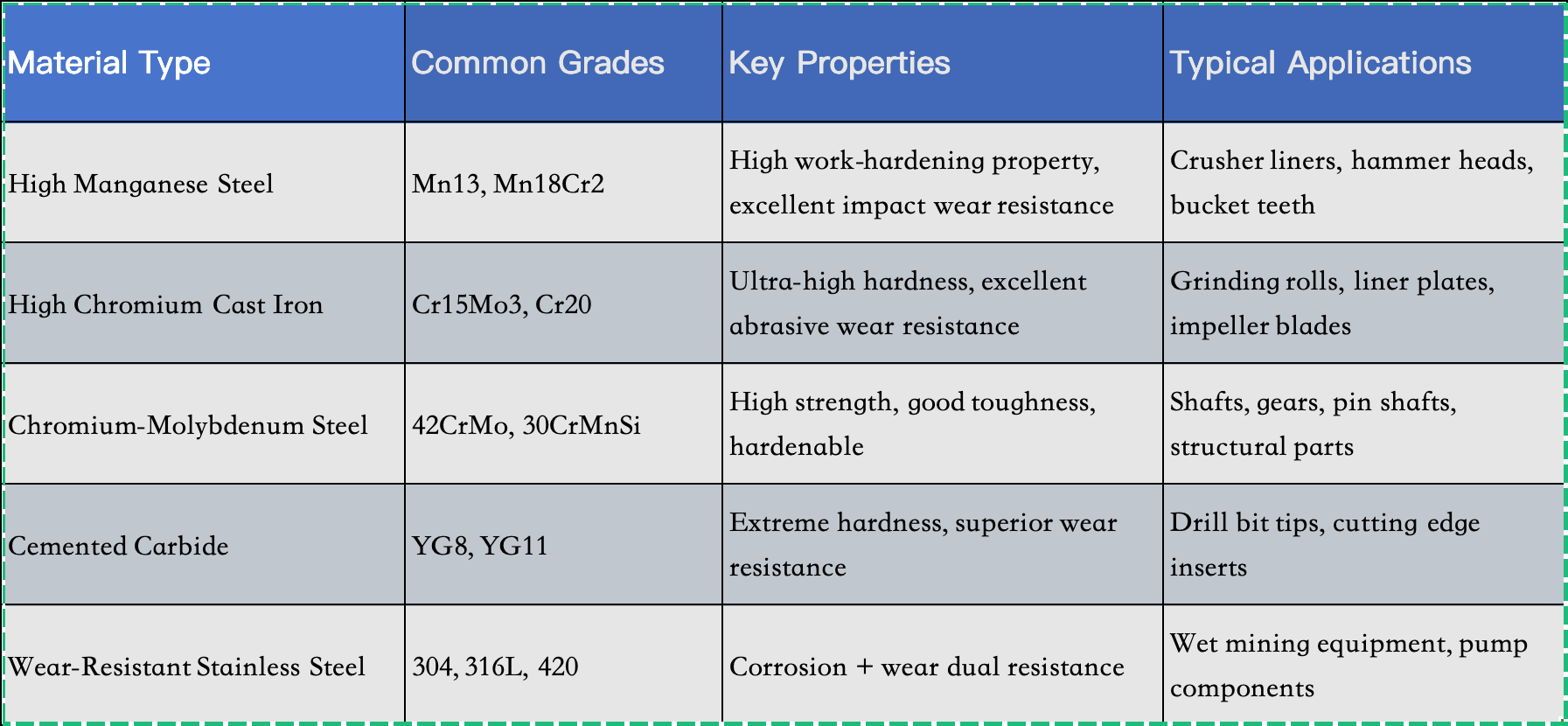
Material selection directly determines part service life. Mining CNC machining prioritizes high-hardness, high-toughness wear-resistant metals, selected based on impact load, abrasive level and working temperature.
Key Machining Challenges of Wear-Resistant Steels for Mining
Wear-resistant steels for mining are notoriously difficult to machine, which is also the core technical threshold for mining CNC machining. The four main challenges are:
Severe tool wear: High hardness and work-hardening properties cause rapid tool edge passivation, requiring specialized carbide tools and optimized cutting parameters.
Machining deformation control: High internal stress in cast and forged wear parts easily leads to dimensional drift during processing, requiring stress relief procedures and reasonable machining sequence.
Deep hole & cavity machining: Thick-walled bushings, cylinder barrels and deep hole features have poor chip removal, easily causing tool breakage and surface burn.
Surface quality impact on wear life: Poor surface finish will accelerate abrasive wear. Mining parts require controlled surface roughness to form a stable lubricating / wear-resistant interface.
DFM Optimization for Mining Wear Parts: Cost-Saving Design Tips
Design for Manufacturability (DFM) can significantly reduce manufacturing cost while ensuring part performance. Five practical optimization strategies for mining parts:
Reasonable tolerance setting: Non-mating surfaces adopt standard tolerance; only critical fitting surfaces apply tight tolerance, avoiding unnecessary precision waste.
Reduce unnecessary machined surfaces: Retain as-cast / as-forged surfaces on non-functional areas, reducing machining time and tool loss.
Reserve wear allowance in design: Integrate predictable wear margin into dimensional design, avoiding premature replacement and extending service intervals.
Process-friendly structure design: Increase transition fillets, avoid sharp corners and deep narrow grooves, reducing tool wear and stress concentration.
Standardize common parts: Standardize dimensions of pins, bushings and liners to achieve batch production and reduce spare parts inventory cost.
Post-Processing & Quality Inspection Standards for Mining Components
Mining parts require targeted post-processing to enhance wear resistance, plus strict quality verification to ensure reliability under heavy duty conditions.
Core Post-Processing Processes
Surface hardening (induction quenching, carburizing): Improve surface hardness while maintaining core toughness
Shot peening: Introduce compressive stress on surface, improve fatigue resistance
Wear-resistant coating (spray welding, overlay welding): Local reinforcement for high-wear areas
Quality Inspection Standards
Full dimensional inspection for critical fitting features
Hardness testing for each batch of heat-treated parts
Non-destructive testing (NDT) for high-load structural parts (cracks, internal defects)
Sample wear test for batch mass production parts
FAQs: CNC Machining for Mining Equipment
What is the typical tolerance for CNC machined mining parts?
General structural parts adopt ±0.05mm ~ ±0.1mm standard tolerance. Critical fitting surfaces such as bearing seats and shaft journals apply ±0.01mm ~ ±0.02mm precision tolerance, depending on assembly requirements.
Which material is best for high-impact mining wear parts?
High manganese steel (Mn13 series) is the preferred choice for high-impact abrasive conditions. It work-hardens under impact, continuously improving surface hardness while maintaining tough core, ideal for crushers and bucket teeth.
Why is wear-resistant steel machining more expensive than ordinary steel?
Wear-resistant steel causes severe tool wear, requires slower cutting speeds, more tool changes and additional stress relief processes. Lower processing efficiency and higher tool consumption result in higher manufacturing costs.
How to extend the service life of mining wear parts?
Optimize material matching according to working conditions, control machining surface quality, adopt targeted surface strengthening treatment, and design reasonable wear allowance. Regular maintenance and timely replacement of vulnerable parts also extend overall equipment life.
Heavy-duty mining equipment demands wear-resistant, impact-resistant and dimensionally stable machined parts. Partnering with an experienced mining CNC machining supplier ensures reliable part performance, reduced downtime and lower total operating costs.
Our mining machining capabilities:
✅ Full range of wear-resistant material processing: manganese steel, high chromium iron, alloy steel, cemented carbide
✅ Precision machining down to ±0.01mm for critical fitting components
✅ In-house heat treatment, surface hardening and wear-resistant coating capabilities
✅ DFM consultation to optimize your design for cost and performance
✅ Flexible production: from one-off replacement parts to batch production
Get started: Send your 2D/3D drawings, material specifications and quantity requirements to konsdun.li@gmail.com. Our engineering team will review manufacturability, provide DFM suggestions and offer a detailed quotation within 24 hours.






 Phone
Phone
Comment
(0)